

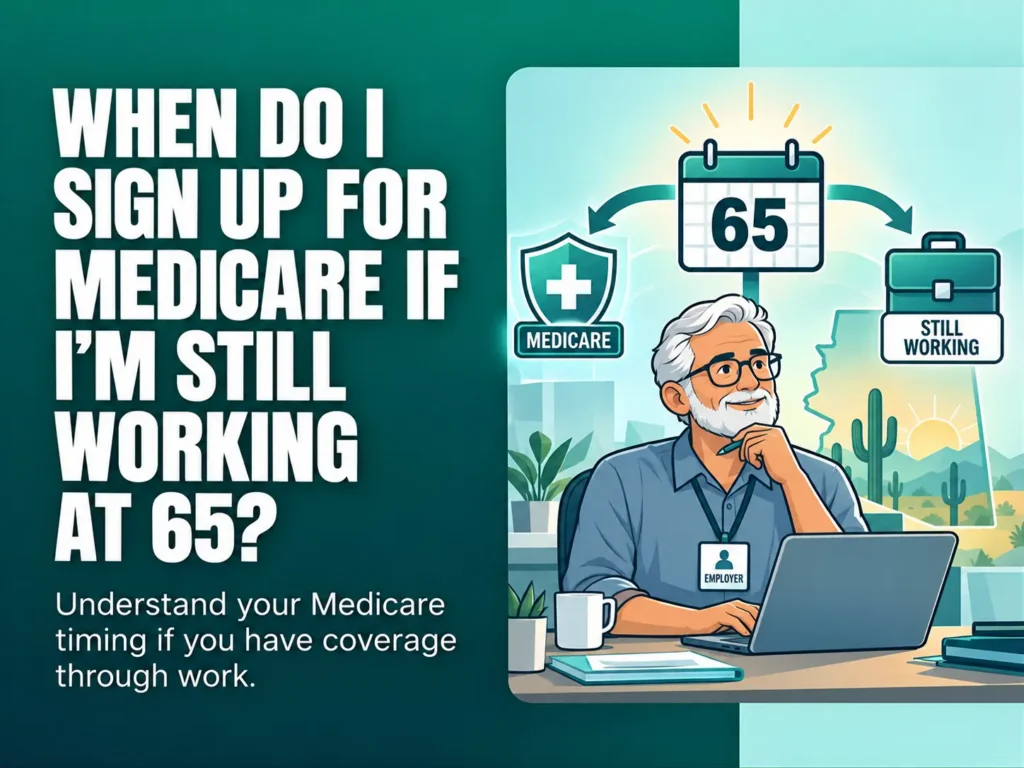
If your employer has 20 or more employees and you are covered by that group plan through active employment, you can generally delay Part B and enroll later through a Special Enrollment Period without a late-enrollment penalty. If your employer has fewer than 20 employees, Medicare usually pays first at 65, and delaying Part B can leave you responsible for a much larger share of your bills. Confirm your employer’s size first — that single fact drives everything else.
When Do I Sign Up for Medicare If I’m Still Working at 65? You Don’t Have to Decide Everything at Once
Most people meet this question the same way. A letter arrives, or a neighbor who retired last spring says something alarming over the fence, and suddenly a birthday feels like a deadline you did not know you had. Take a breath. “Still working at 65” is not one situation with one answer. It is four separate questions, and the right sequence depends on which ones apply to you.
Those four questions are: how many employees does the plan’s employer have, are you contributing to a Health Savings Account, who else is covered on your plan, and have you already filed for Social Security. Work through them in that order and the timing decision usually becomes clear.
Before we go further, three plain-English definitions, because the rest of this only makes sense with them:
- Part A is hospital insurance. For most people who worked and paid Medicare taxes long enough — or whose spouse did — there is no monthly premium for it.
- Part B is doctor visits, outpatient care, labs, imaging, and durable medical equipment. It has a monthly premium, and that premium is why people wonder whether to delay it.
- Creditable coverage, in the Part B context, means active employer group health coverage based on current employment — yours or your spouse’s. That is the kind of coverage that lets you postpone Part B without a penalty later. Retiree coverage and COBRA generally do not count for this purpose, which surprises people at exactly the wrong moment.
Nothing below is an eligibility determination. Medicare and Social Security decide who qualifies and when. What follows is how to gather the facts they will ask you about.
Does Your Employer Have 20 or More Employees? That One Number Changes Everything
This is the fork in the road, and almost every confusing conversation about working past 65 traces back to it.
Medicare has coordination-of-benefits rules that decide which plan pays first. When an employer has 20 or more employees, the group health plan is generally the primary payer for an employee who is 65 and still actively working, and Medicare would pay second if you enrolled. Because the group plan is still doing the heavy lifting, you can usually postpone Part B and pick it up later when employment or that coverage ends.
When the employer has fewer than 20 employees, the order typically flips. Medicare becomes the primary payer once you are eligible, and the small-group plan pays secondary. That is the situation that quietly hurts people. If Medicare is supposed to pay first and you never enrolled in Part B, there is no first payer. Some small-group plans will process claims as though Medicare had paid its share — leaving you holding the difference on an outpatient surgery, an imaging series, or a specialist run you assumed was covered at the level you were used to.
How employee counts actually work
The count is not “how many people are on the health plan.” It is generally based on how many employees the employer had for a certain number of calendar weeks in the current or prior year, and it includes employees who waived coverage. Part-time workers may count. Related businesses under common ownership may be combined. If you work for a company with multiple locations, the count is usually company-wide, not just your office.
So do not guess, and do not rely on a hallway estimate. Ask your HR contact or plan administrator in writing, and ask the question in the form the answer needs to take:
- “For Medicare Secondary Payer purposes, does the employer have 20 or more employees?”
- “Is this plan primary or secondary for an active employee who is 65 and Medicare-eligible?”
- “If I enroll only in Part A and not Part B, how will this plan process my claims?”
Keep the reply. An email is fine. That paper trail matters more than any advice you will get, including ours.
Why we see the small-employer version constantly out here
Queen Creek, San Tan Valley, Apache Junction, Florence, and Gold Canyon run on small businesses — contractors, landscape and irrigation outfits, dental and veterinary practices, restaurants, family trades, two-truck HVAC companies. A great many of those employers sit well under 20 people. Because this agency places small-group plans and also reviews Medicare for the same households, we see this exact mismatch often: a loyal 66-year-old employee on a small-group plan who assumed “I have insurance through work, so I’m fine,” and never enrolled in Part B.
There is a version of this for owners, too. If you are the small-business owner turning 65, you are both the employer and the employee in this question. You may be paying most of the group premium, and enrolling in Medicare yourself can change what the group plan should look like for everyone else on it — including whether the plan still makes sense at its current tier structure. That is a two-sided conversation, not a one-form decision.
Should I Take Part A at 65 If I’m Still Working? The HSA Question Nobody Warns You About
Part A usually carries no premium, so taking it at 65 feels like an obvious yes. For many people it is. But there is one situation where it is not, and it is the single most common expensive surprise we see among working 65-year-olds: the Health Savings Account.
Here is the rule in plain terms. You cannot make new contributions to an HSA in any month you have Medicare — including a month where you have only premium-free Part A. Enrollment and eligibility to contribute do not coexist. If your paycheck keeps routing money into your HSA after your Medicare starts, those become excess contributions, and unwinding them means corrective distributions, paperwork, and possible tax consequences.
The part that catches people is the retroactive start date. If you enroll in Part A after your 65th birthday has passed, your coverage can be backdated — up to six months, though never earlier than the month you turned 65. That backdating is invisible until you look at the effective date on your card and realize it precedes contributions you already made. Practically, that means if you intend to enroll in Part A at some point after 65, you generally want to stop HSA contributions roughly six months before that enrollment, not the week of.
What you do not lose is the money already in the account. An existing HSA balance can still be spent tax-free on qualified expenses, and once you are on Medicare that list includes your Part B premiums, Part D premiums, deductibles, copays, and coinsurance. Many people who delay Part B keep contributing while they can and then treat the balance as a premium reserve for the Medicare years. Medigap premiums are a notable exception — they are generally not a qualified HSA expense.
If your spouse is the account holder and you are simply covered by their high-deductible plan, your Medicare enrollment does not automatically end their ability to contribute. Their eligibility is what governs their contributions, though the family contribution limit and who is still HSA-eligible can shift the math. This is precisely the point where you stop reading articles and call your tax preparer — contribution limits, corrective distributions, and the tax treatment of any of it are their territory, not an insurance agent’s. Bring them your intended Part A effective date and let them tell you when the contributions need to stop.
Who Else Is on Your Plan? Your Spouse and Kids Change the Math
Medicare covers one person. Not a household, not a family tier, not a spouse and not a 19-year-old still on your plan while she finishes at Mesa Community College. That sentence is the whole section, and it is the part most national explainers skip.
If you drop employer coverage to move onto Medicare, everyone else on that policy loses coverage at the same time unless they have somewhere to go. Sometimes they do: the group plan may allow them to stay enrolled without you, or your spouse may have their own employer option, or individual coverage through the Arizona marketplace may be workable — losing job-based coverage is generally a qualifying event that opens an enrollment window for them. But that has to be arranged before you sign anything, not discovered afterward.
Now the reverse situation, which is just as common out here. You are turning 65 and you are covered as a dependent on your working spouse’s plan. In that case, it is their employer’s size that drives your timing, not any former employer of yours. A spouse working for a 300-person company in Chandler puts you in a different position than a spouse working for a six-person shop in San Tan Valley — same birthday, different answer.
The number that should decide this is not your Part B premium in isolation. It is total household cost: what the family stays enrolled in, what everyone’s deductibles and out-of-pocket maximums look like, and whether the group plan’s premium drops meaningfully when you come off it. Sometimes the household saves money. Sometimes a younger spouse’s replacement coverage costs more than you saved. You want that comparison on one page before you decide.
Do I Have to Take Social Security to Get Medicare at 65?
No. Medicare and Social Security are administered by the same agency and applied for through the same front door, which is why people assume they are one decision. They are two independent choices, and plenty of people take one without the other.
There is one important connection. If you are already receiving Social Security retirement benefits when you approach 65, you are typically enrolled in Part A and Part B automatically. Your card and a welcome packet arrive in the mail a few months before your birthday month, and the packet explains what to do if you do not want Part B — including a response window and instructions for returning or declining it. If your plan was to delay Part B because you have a large-employer plan, that envelope is not junk mail. Open it, read the deadline, and act inside it. People who set it on the counter end up paying a Part B premium they did not intend to pay, or worse, get their group plan’s claims processing rearranged without realizing why.
If you are not drawing Social Security yet and you do enroll in Part B, the premium is not deducted from a check that does not exist. Medicare bills you directly — typically on a quarterly schedule — and you can arrange automatic payment. Later, when you do file for Social Security, the premium generally shifts to being withheld from your monthly benefit.
When to claim Social Security is a retirement-income question involving your full retirement age, your earnings, and your spouse’s record. Decide it on its own merits. Just know that filing for it will likely pull Medicare along with it.
When Filing for Part B at 65 Makes Sense Even Though You’re Still Working
The default advice you will hear is “if you’re working, just delay.” That is sound for a lot of people with large-employer coverage. It is wrong often enough that it deserves a counterweight. Situations where enrolling in Part B on time is frequently the better call:
- Your employer has fewer than 20 employees. Medicare is generally the primary payer anyway. Delaying does not save you exposure; it creates it.
- Your share of the group premium is high — especially on employee-plus-spouse or family tiers, where employer contributions often thin out dramatically compared to employee-only.
- Your group plan is a high-deductible plan and you are actively using care. A large deductible plus coinsurance is a very different financial picture than Part B plus a supplement or an Advantage plan with a defined maximum out-of-pocket.
- You take expensive prescriptions. Group formularies and Medicare drug coverage price the same medication very differently. Sometimes the group plan wins decisively. Sometimes it does not, and it is worth checking rather than assuming.
- Your spouse would be better off on their own coverage. If coming off the family tier drops the household premium substantially, that changes the whole comparison.
Here is the comparison to actually run, side by side, on one sheet of paper:
- Total household monthly premium under each scenario — your Part B premium and any supplement or Advantage plan premium, plus whatever the rest of the family pays.
- Deductibles, copays, coinsurance, and the maximum out-of-pocket on each side, because the out-of-pocket ceiling is what protects you in a bad year.
- Whether your current doctors participate. Networks in the East Valley are not interchangeable — a cardiologist affiliated with one Banner or Dignity Health facility may be in one plan’s network and not another’s, and specialists in Gilbert and Chandler do not all contract identically. Verify your own physicians by name, every year.
- Each of your medications, checked against the specific drug list on each side, at the pharmacy you actually use.
No single answer fits everyone here. Two people who work at the same Queen Creek company, turn 65 the same month, and earn similar pay can land on opposite decisions because one has a 58-year-old spouse and three medications and the other is single and healthy. This is a math problem specific to your household, and it is worth doing carefully once rather than guessing and living with it.
When You Do Retire: The Eight-Month Window and the Two Forms That Prove You Weren’t Late
If you delayed Part B while working, a Special Enrollment Period opens when your employment ends or when that group coverage ends — generally whichever happens first. You have eight months from that point to enroll in Part B without a late-enrollment penalty. That sounds generous. It is not, because most people should be finishing the paperwork in the first weeks of it, not the eighth month, and because Part B start dates do not always land where you assume.
The trap: COBRA and retiree coverage generally do not count as active employer coverage for Part B purposes. Electing 18 months of COBRA does not extend your window — your clock started when active employment ended. We have written separately about how the Part B late enrollment penalty is calculated and why it follows you permanently; the short version is that it is a lifelong surcharge, and the eight-month window is the thing that protects you from it.
Two forms matter. The Part B application itself, and the employer-completed verification form documenting that you had group coverage based on current employment. Get that second form signed before your last day, while your HR contact still knows your name and your file is still open. Chasing a signature from a company that has been acquired, downsized, or shut down is a miserable errand, and the East Valley has plenty of small employers that no longer exist. If you truly cannot get it, gather substitutes — pay stubs showing premium deductions, W-2s, insurance cards, plan statements — and expect the process to take longer.
Start about two to three months before your coverage ends so your Part B effective date can line up with the day the group plan stops, and any supplement or drug coverage can start the same day. A gap of even a few weeks is a real exposure, not a technicality.
A Simple Order of Operations — and Where to Get a Second Set of Eyes in the East Valley
Do these in order and you will not get this wrong:
- Confirm your employer’s size and whether the plan pays primary or secondary — in writing.
- Check whether anyone is still contributing to an HSA, and pick your Part A timing around it.
- List who else is covered on your plan and where they would land.
- Check your Social Security status, and open any Medicare packet that arrives.
- Compare total household cost, networks, and prescriptions before choosing.
If you want a second look, bring five things: your current plan summary, what you actually pay per paycheck, a list of your doctors, a list of your medications with doses, and your HSA statement if you have one. Because this agency reviews small-group employer plans and Medicare for the same Queen Creek and San Tan Valley households, we can put both columns on the same page instead of only the Medicare one.
One honest limit: eligibility and enrollment determinations are made by Medicare and the Social Security Administration, not by an agent. What we can do is help you gather the right facts, read your own plan accurately, and understand what each choice would mean for your doctors, your prescriptions, and your household budget.