

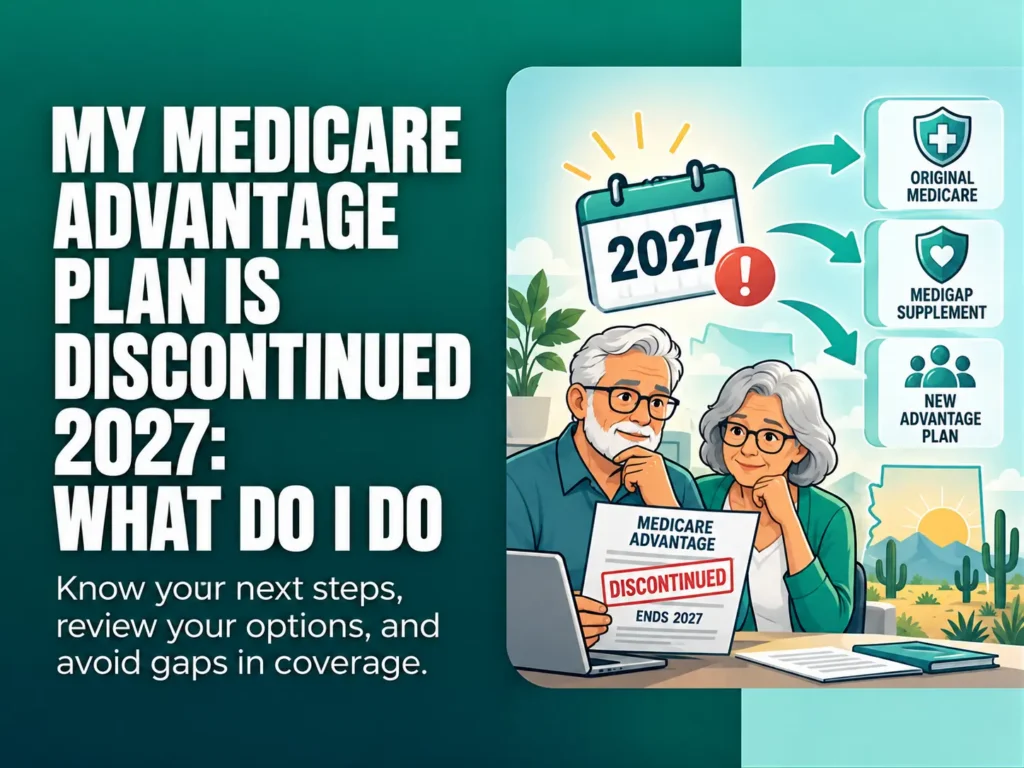
If a letter says your Medicare Advantage plan will not be offered in 2027, your Medicare itself is intact — only that particular plan is ending, and it ends on December 31, 2026. You have the fall Annual Enrollment Period that closes December 7, a special enrollment period that a non-renewal usually opens after it, and a much shorter window to apply for a Medicare Supplement without answering health questions. Read the letter, write down its dates, then compare what is actually offered at your address.
My Medicare Advantage Plan Is Being Discontinued in 2027: What Do I Do? First, Know the Letter Is Real
Every fall, Medicare Advantage members get mail. Most of it is routine. This year, some of it is not, and the difference matters enormously.
Carriers have been trimming their Medicare Advantage lineups for 2027. Healthcare Dive reported on July 29, 2026, that Humana planned to exit additional Medicare Advantage plans for the 2027 plan year. On August 14, 2026, 24/7 Wall St. reported that the plans being dropped cover roughly 600,000 Medicare members and that the notices were expected to land in September. If a letter arrived at your house in Queen Creek, San Tan Valley, Apache Junction, or Gold Canyon with unfamiliar wording about your plan not continuing, you are not misreading it, and you are not the only one on your street.
Here is the distinction to hold onto. The Annual Notice of Change, often called the ANOC, goes to every Medicare Advantage member every fall. It describes what your existing plan will look like next year — the premium, the copays, the drug list, the extras. Your plan continues; the details shift. A non-renewal notice — sometimes worded as a plan termination — says something different. It says the plan you are enrolled in will not be offered in your county in 2027 at all. There is no version of it to keep.
That is a business decision a carrier made about a product in a service area. It is not a judgment about your health, your claims history, or anything you did. Your Medicare Part A and Part B entitlement does not disappear because a plan leaves. What changes is the private plan that has been administering your benefits, and that means you get to choose again — on a calendar you did not pick.
How Do I Know If My Plan Is Ending or Just Changing?
Put the letter flat on the kitchen table and look for four things.
The verb. Termination language sounds final and specific: “will no longer be offered,” “is being non-renewed,” “is terminating,” “will not be available in your county for 2027.” Change language that sounds comparative: “changes for 2027,” “your new copay will be,” “beginning January 1, your plan will.” If the letter is telling you what next year’s benefits will be, the plan is surviving. If it is telling you when coverage stops, it is not.
The end date. A non-renewal notice states a date your coverage ends, and it is almost always December 31, 2026. An Annual Notice of Change has no end date, because nothing ends.
The plan identity. Near the top or bottom of the page, you will usually find the plan name, a contract number that starts with a letter, and a plan ID — something in the shape of H1234-005. Copy those characters down exactly. Every later conversation, with a doctor’s office or a pharmacy or an advisor, gets faster when you can name the specific plan rather than “my Humana plan” or “my Advantage plan.”
The geography. Non-renewals are often county-level. A plan can leave Pinal County and continue in another part of the state or country. That is exactly why searching the plan name online is so confusing — you find pages saying the plan exists, because somewhere it does, just not where you live.
Then treat the letter like a document, not junk mail. Keep it. Photograph the front page and the envelope so you have the postmark. If the wording is ambiguous, call the member services number printed on the back of your plan ID card and ask one direct question: “Is my plan being offered in my county in 2027, yes or no?” You can also bring the letter to a local advisor and have it read with you.
What Happens to My Coverage if I Do Nothing?
Doing nothing produces one of two outcomes, and neither one is a choice you would likely make on purpose.
Outcome one: you land on Original Medicare on January 1, 2027. Parts A and B still cover hospital and medical services the way they always have. But the pieces your Advantage plan was bundling around them go away. There is no prescription drug coverage attached, because drug coverage in Original Medicare comes from a separate Part D plan you have to enroll in. There are no dental, vision, hearing or fitness extras. And Original Medicare on its own has no annual limit on what you can spend out of pocket — after the Part B deductible, you are generally responsible for a share of the cost of covered services, with no ceiling that stops the bleeding in a bad year. That is the gap a Medicare Supplement is designed to sit in.
Outcome two: the carrier moves you into another plan it still offers. This can happen when a company is discontinuing one plan but keeping a similar one in your area. It sounds convenient. The risk is that “similar” is doing a lot of work in that sentence. The replacement can have a different provider network, a different drug list, different copays for specialists and imaging, and a different maximum out-of-pocket amount. You did not compare it to anything. You were assigned it.
There is one more consequence worth understanding plainly. If you end up without drug coverage that Medicare considers creditable and you go without it for a stretch of months, a Part D late enrollment penalty can be added to your drug premium later — and once it attaches, it generally stays with you for as long as you have Part D. This is not a scare tactic and it is not a fine anyone can waive as a favor. It is arithmetic in the program’s rules, and it is one of the quieter costs of letting a non-renewal letter sit in a pile until February.
Your Three Windows: Annual Enrollment, the Special Period, and the Supplement Clock
Most people think they have one deadline. You actually have three, and they do not expire in the order you would guess.
Window one: the Annual Enrollment Period
The fall Annual Enrollment Period runs from October 15 through December 7, and anything you choose during it takes effect January 1. This is the cleanest path: you pick a 2027 Medicare Advantage plan or a Part D plan while everyone is shopping, and your new coverage starts the same day your old plan stops. No gap, no scramble. If you can make a decision by early December, make it here.
Window two: the special enrollment period a non-renewal opens
If December 7 passes and you have not chosen, a plan termination does not leave you stranded. Medicare generally opens a special enrollment period for people whose plan is leaving their area, and it typically extends past the regular deadline into the new year. Separately, people enrolled in a Medicare Advantage plan have an opportunity in the first months of the calendar year to make a change. What these later windows do not do is prevent a coverage gap — if you enroll in January, your new plan usually starts the first of the following month, and you spend the interim on Original Medicare alone. Confirm the exact dates that apply to your situation against your own letter and with Medicare, because they depend on when your notice was dated and when your coverage ends.
Window three: the supplement clock, which runs out first
This is the one people miss. When a plan terminates, federal Medigap protections can give you the right to buy certain Medicare Supplement policies without answering health questions. That right is time-limited, and it is measured in days from your coverage-end date or your notice date — not in months, and not on the same calendar as Annual Enrollment.
Think about how that plays out in real life. You get the letter in September. You spend October and November comparing Advantage plans, which is a reasonable thing to do. By the time you start wondering whether a supplement would actually suit you better, the window in which a supplement carrier had to issue you a policy regardless of your health history may be closing or closed. Supplement applications also take time to complete and process. If a supplement is even a possibility for you, look at it early — in the same sitting as the Advantage plans, not after them. And get your specific dates confirmed in writing rather than trusting a generic calendar you found online.
Another Advantage Plan or a Medicare Supplement? What a Non-Renewal Changes
In an ordinary year, moving from Medicare Advantage to a Medicare Supplement in Arizona usually involves medical underwriting — the carrier asks health questions about conditions, medications, surgeries and pending procedures, and the answers can affect whether a policy is issued to you and at what rate. That single fact is why many people who would prefer a supplement stay where they are.
A plan termination can change that conversation, for a limited time, by triggering Medigap protections that let you buy certain supplement plans without those health questions. That is why the decision deserves real thought this year even if you have been content on an Advantage plan for a decade. The door is open in a way it may not be next fall.
Here is what each path looks like in practice.
A Medicare Supplement plus a standalone Part D plan. You keep Original Medicare, add a Medigap policy that picks up much of the cost-sharing Parts A and B leave behind, and add a separate Part D plan for prescriptions. You are paying two monthly premiums plus your Part B premium. In exchange, your costs at the point of care become far more predictable, and you can generally see any provider who accepts Medicare — which matters if you travel, split time out of state, or want a specialist in Phoenix or Tucson without checking a network first. What you give up: the dental, vision and hearing extras bundled into many Advantage plans, and a lower monthly outlay.
Another Medicare Advantage plan. Premiums are typically lower, sometimes considerably, and the extras are often built in. You accept a network, referral rules in some plan types, copays for visits and services, and an annual maximum out-of-pocket amount that caps your exposure in a bad year. What you give up: the ability to ignore networks and some predictability month to month.
Neither is the right answer for everyone, and no honest advisor will tell you otherwise. The most common thing we see at a kitchen table is a husband and wife on the same discontinued plan reaching two different conclusions — one takes prescriptions and sees three specialists and wants predictability, the other is healthy, on one generic, and would rather keep the premium low and the dental benefit. Both can be reasonable. What matters is that the choice gets made against your own doctors, your own medication list and your own budget, not against an average.
Will I Keep My Doctor? Pinal and Maricopa Networks Are Not the Same Map
Medicare Advantage plan availability is set by county — and in some cases refined by ZIP code. That is not a technicality out here. Queen Creek and San Tan Valley straddle the Pinal–Maricopa line, so two neighbors who lost the same plan can open a comparison and see different 2027 menus. A household on the Pinal side and a household in Gilbert ten minutes up the road are shopping in two different markets.
So the honest answer to “will I keep my doctor” is: possibly, and it has to be checked plan by plan, not assumed. The practical order of operations looks like this.
- Write down every provider you actually want to keep — primary care, cardiology, oncology, orthopedics, endocrinology, your dermatologist, the pain management group, the imaging center you like.
- Add the hospital systems that matter to you. Around here that usually means Banner, Dignity Health, Mountain Vista and the East Valley specialty groups people are already established with.
- For each replacement plan you are seriously considering, check participation for those specific providers — then verify.
Verification matters because online provider directories lag. They are updated on the carrier’s schedule, not the practice’s, and contracts for a new plan year are sometimes still being finalized while directories still show last year’s picture. The reliable move is a phone call to the practice’s billing or front desk with the exact plan name, contract number and plan ID from your comparison — not “do you take Medicare Advantage,” which almost always gets a yes that means nothing.
One more thing people forget: care that crosses January 1. If you have a referral, an authorization, a scheduled surgery, an infusion series or a course of therapy that continues into 2027, ask both the practice and the new plan how it will be handled. Some plans offer a transition or continuity-of-care process for treatment already underway. It is far easier to arrange that in November than to discover a problem the morning of a procedure.
What Happens to My Prescriptions?
Before you compare a single plan, build the list. Every medication, the exact dose, how often you take it, and the pharmacy you fill it at. Brand versus generic matters. Dose matters, because tiers can differ by strength.
Then check each drug against each plan’s formulary — the plan’s list of covered drugs, sorted into tiers that determine your share of the cost. A medication can be on both plans’ lists and still cost you very differently, because a move from a preferred generic tier to a non-preferred or specialty tier changes your copay. Some drugs also carry requirements like prior authorization, step therapy or quantity limits, which are worth spotting in advance rather than at the counter.
The pharmacy matters as much as the drug list. Most Part D and Advantage drug benefits have preferred pharmacies where your cost-share is lower, standard pharmacies where it is higher, and a mail-order option that can price differently again — especially on 90-day fills of maintenance medications. The plan that looks best on premium can lose on the pharmacy you actually drive to.
And if you are considering the supplement path, remember that a Medicare Supplement does not include prescription coverage. Choosing a supplement means shopping a standalone Part D plan in the same sitting, against the same medication list. Two decisions, one appointment.
What to Bring to a Non-Renewal Review in Queen Creek
A good review takes about an hour when you arrive prepared. Gather these first:
- The non-renewal letter itself, envelope included
- Your red, white, and blue Medicare card
- Your current plan ID card
- A written list of your doctors, specialists and preferred hospital
- Your medication list with doses and your pharmacy
- A realistic monthly number you are comfortable spending on premiums
- Any upcoming procedures, referrals, or authorizations already scheduled
Here is what the review itself covers. You start with your address, because that determines which county’s plan menu applies to you. You look at the plans actually offered at your ZIP for 2027 — not a national list — and screen them against your providers, your prescriptions, and your budget. Where a supplement is worth considering, you walk through what the application involves, including the health questions and how a plan termination can change whether they apply to you right now. You compare the total picture: premium, copays, maximum out-of-pocket, drug costs at your pharmacy, and the extras you would actually use.
You will not be asked to decide the same day. Some people need to call a specialist’s office first, or talk it over with a spouse or an adult child, and that is a completely normal part of this. What we do ask is that you start before December rather than after it — the fall window closes on December 7, and the window to apply for a supplement without health questions can close even sooner. A neighbor down the road can sit with you, read your letter, and show you what your actual options look like in Pinal and Maricopa counties.