

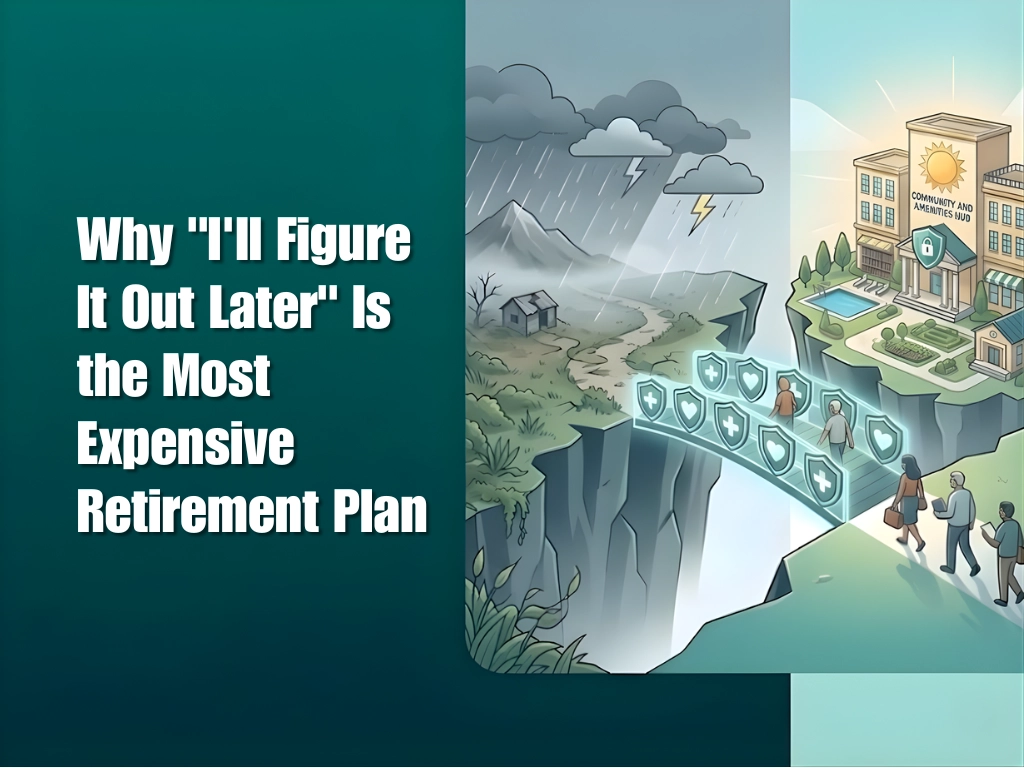
Most people don’t plan to fail at retirement. They keep pushing the planning to tomorrow — and tomorrow quietly turns into a decade. “I’ll figure it out later” feels harmless when you’re 35, busy with kids, a mortgage, and a job that demands everything you have. But that four-word phrase carries a price tag most people never see coming until it’s too late to do much about it.
This isn’t a scary piece. It’s a practical look at what procrastinating on retirement planning — especially the health insurance side of it — actually costs you in real dollars, real stress, and real lost options. If you’re in your 30s, 40s, or even early 50s and you haven’t gotten serious about this yet, you’re not alone. But you are running out of cheap runway.
The Compounding Problem Nobody Talks About Enough
Most retirement conversations start with investment accounts, and that’s fair — compound interest is genuinely powerful. But the flip side is equally true: compound inaction is just as powerful, and it works against you with the same relentless math.
Here’s a straightforward example. If you invest $500 a month starting at age 30, and you earn an average annual return of 7%, you’ll have roughly $1.2 million by age 65. If you wait until 40 to start the same contribution, you’ll have about $567,000. That’s not a small difference — that’s more than $600,000 in lost wealth from a single decade of delay. The money you didn’t lose to bad investments or market crashes. The money you lost to waiting.
Compound interest doesn’t care about your reasons. It doesn’t account for the fact that you were paying off student loans or dealing with a career transition. It just runs the numbers. And the numbers punish delays severely.
Now add healthcare costs into that picture, and the gap widens even further. Healthcare inflation has consistently outpaced general inflation for the past 30 years. What costs $10,000 today to manage a chronic condition will cost significantly more in 20 years. People who plan early can build those projected costs into their strategy. People who plan late are forced to scramble and often make reactive decisions that cost far more in the long run.
What “Later” Actually Looks Like in Practice
The problem with “later” is that it never announces itself. You don’t get a calendar notification that says “Today is the last affordable day to plan for retirement.” Instead, it tends to arrive as a series of unpleasant surprises.
You hit 55 and realize your 401(k) balance is far short of where it needs to be. You start calculating Social Security benefits and discover that claiming early — which you may be forced to do if you can’t keep working — permanently reduces your monthly payment. You look at your projected healthcare costs in retirement and realize you didn’t account for the years between leaving your employer’s coverage and qualifying for Medicare at 65. Suddenly, “later” has a dollar sign in front of it.
For a couple retiring at 62, the gap between losing employer-sponsored health insurance and qualifying for Medicare is three years. During those three years, you’re responsible for your own coverage. According to consistent industry data, a healthy couple in their early 60s can expect to pay between $1,200 and $2,000 per month for a solid individual market health insurance plan, depending on location, plan tier, and whether any subsidies apply. Over three years, that’s between $43,000 and $72,000 in premiums alone — before deductibles, copays, or any actual medical care.
That number doesn’t go down if you didn’t plan for it. It just comes out of retirement savings you hadn’t budgeted to spend that way.
Healthcare Is the Retirement Variable Most People Underestimate
If you ask the average person what their biggest retirement expense will be, most will say housing. Some will say food. Very few will say healthcare, but healthcare consistently ranks as one of the top two retirement expenses for most Americans, and it’s the one with the most unpredictability built in.
Fidelity’s annual retirement healthcare cost estimate — one of the most referenced benchmarks in the industry — has put the projected healthcare cost for a 65-year-old couple retiring today at over $315,000 over the course of their retirement. That number accounts for Medicare premiums, out-of-pocket costs, and supplemental coverage. It does not account for long-term care.
Here’s what makes this particularly difficult: healthcare costs in retirement don’t follow a predictable schedule. You might have relatively low costs in your mid-60s, then face a major health event in your 70s that wipes out several years of careful saving. Planning for this requires more than just having “enough money.” It requires having the right coverage structure in place before a health event forces your hand.
Medicare Isn’t Free — And It Isn’t Enough on Its Own
One of the most persistent myths in retirement planning is that Medicare takes care of everything once you turn 65. It doesn’t. Medicare Part A covers hospital stays, but most people don’t pay a premium for it. Part B covers outpatient care and comes with a monthly premium that increases as your income rises. Part D covers prescription drugs and has its own premium and coverage gaps.
Even with all three parts, Medicare has deductibles, copays, and significant out-of-pocket expenses. That’s why most financially prepared retirees pair Medicare with either a Medicare Supplement (Medigap) plan or a Medicare Advantage plan to fill in the gaps. Both options have costs and trade-offs, and the right choice depends heavily on your health status, prescription needs, preferred doctors, and financial situation.
Making this decision well requires planning before you turn 65 — not the week of your birthday. Enrollment windows matter. Missing them can result in lifetime premium penalties or coverage gaps that are very difficult to reverse.
The Coverage Gap Between Retirement and Medicare
If you plan to retire before 65 — whether by choice or necessity — you need a health insurance bridge strategy. This is one of the most overlooked and costly planning failures people make.
Your options during this gap period include COBRA continuation coverage from your former employer, ACA marketplace plans, a spouse’s employer plan if applicable, or short-term health insurance. Each option has different premium levels, coverage quality, and eligibility requirements. ACA marketplace plans, for example, can be quite affordable if your income in early retirement falls within certain thresholds that qualify you for premium tax credits. But that only works if you structure your retirement income strategy with those thresholds in mind — which requires planning well in advance.
This is exactly the kind of strategic overlap — between retirement income planning and health insurance planning — that most people never address because they’re dealing with each piece separately, or not at all.
Why People Keep Putting This Off
Understanding why people procrastinate is actually useful here, because the reasons are legitimate and the barriers are real. This isn’t about people being irresponsible. Retirement planning feels abstract when you’re decades away from it. The costs are distant and uncertain. The decisions are complex and require engaging with topics — insurance, investment accounts, tax strategy — that aren’t exactly enjoyable for most people.
There’s also a psychological phenomenon called “present bias,” where the brain heavily discounts future rewards and costs in favor of what’s immediate. Spending $300 on something fun today feels more real than saving $300 for a retirement that’s 25 years away. This is why financial advisors who simply tell people to “save more” often get nowhere. Knowing what to do and actually doing it are entirely different things when the human brain is involved.
Beyond psychology, there are structural reasons people delay:
- Life events like job changes, divorces, or family health crises redirect financial energy and attention
- Conflicting advice from different financial “experts” creates paralysis
- The perceived complexity of health insurance options causes people to defer the decision entirely
- Many people assume their employer’s HR team or a future financial advisor will handle the details when the time comes
The problem is that by the time “the time comes,” you’ve already made the most important decisions by default — and default decisions are rarely optimized decisions.
What Smart Retirement Planning Actually Looks Like
Getting serious about retirement planning doesn’t require having all the answers today. It requires building a framework and starting to fill it in systematically. The people who retire well rarely figure everything out at once. They started with what they knew, got guidance on what they didn’t, and adjusted along the way.
Start With What You Know Right Now
The first step is an honest inventory. How much do you currently have saved? What are your current monthly expenses? What does your Social Security statement say about your projected benefit at different retirement ages? Do you have any pension income coming? Do you have a spouse whose retirement timing and coverage you need to coordinate with?
These aren’t difficult questions, but most people have never actually sat down and answered them in the same room at the same time. Doing that creates clarity that tends to motivate action. Ambiguity is where procrastination thrives.
Health Insurance Deserves Its Own Section of the Plan
Treating health insurance as an afterthought to your retirement plan is one of the costliest structural mistakes people make. It needs its own section, its own budget line, and its own strategy — because it interacts with nearly every other element of your plan.
Your retirement income level affects your ACA subsidy eligibility. Your subsidy eligibility affects which plans you can afford. The plan you choose affects which doctors you can see and which drugs are covered. All of this connects directly to your quality of life and financial security in retirement. Getting this right requires working with someone who understands both the insurance side and the financial planning side — or at a minimum, consulting specialists in each area who communicate with each other.
At Health Insurance JEDI, we work specifically with individuals and families navigating health insurance decisions at every stage — including the often-confusing transition into retirement coverage. Whether you’re trying to understand your ACA options before 65, figuring out Medicare enrollment, or just trying to figure out what you’ll actually pay out of pocket, having a clear picture of your coverage options changes the entire retirement conversation.
The Real Difference Between Prepared and Unprepared Retirees
The difference between people who retire comfortably and people who retire stressed isn’t usually income. It’s planning. Specifically, it’s the gap between those who built a comprehensive, realistic picture of their retirement costs — including healthcare — and those who estimated vaguely and hoped for the best.
Prepared retirees tend to know their projected Medicare premiums, have a plan for long-term care exposure, and have structured their income in a way that minimizes unnecessary tax liability while preserving subsidy eligibility or Medicare premium tiers. They made decisions while they still had options.
Unprepared retirees often find themselves making reactive decisions. They claim Social Security early because they need the income, permanently reducing their lifetime benefit. They skip Medicare Supplement coverage to save on premiums, then get hit with a major hospitalization bill. They hold off on seeing doctors because they’re worried about costs, which leads to more expensive interventions down the road.
The prepared group didn’t necessarily earn more or work harder. They just started the conversation earlier and kept updating their plan as their situation changed.
Conclusion
“I’ll figure it out later” is one of the most natural phrases in the human vocabulary, and in most areas of life, it works out fine. Retirement and health insurance planning are two notable exceptions.
Every year you delay costs you compound growth you can never recover. Every year you delay on health insurance planning means one more year of decisions made without a real strategy behind them. The gap between retiring at 62 and qualifying for Medicare at 65 doesn’t shrink because you didn’t think about it. The premiums don’t negotiate themselves. The enrollment windows don’t wait.
The good news is that starting now — even if “now” is later than it should have been — is still dramatically better than starting even later. Compound math works both ways. Every year you invest well, plan carefully, and make informed coverage decisions is a year that builds on the next one.
If you’re in Queen Creek, the greater Phoenix area, or anywhere in Arizona, and you’re trying to make sense of health insurance for your retirement years, Health Insurance JEDI exists exactly for this. We help people cut through the complexity, understand their real options, and build coverage strategies that actually fit their life — not just their premium budget.
The best time to figure this out was ten years ago. The second-best time is today.